
Why Mythology Needs a Rebrand
When you think of mythology, I assume the image of Greek gods and goddesses flash in your mind. Poseidon, with his trident controlling the waves, or Zeus sending down lightning bolts to mess with the humans below. And while that is part of it, that’s just a little glimpse into that specific moment in time. But mythology branches out swiftly in both directions before that period and after. So today we are gonna get into what mythology really is.
I will tell you the story of the oldest known myth, how mythology has evolved over time and why its absence today might be making our lives a little bit harder. Let’s dive in.
Joseph Campbell’s Four Functions of Myth
The author Joseph Campbell is a well-known mythologist, and he said that the individual has to find an aspect of myth that relates to their life and that a myth should serve four main functions, the mystical function, the cosmological function, the sociological function, and the pedagogical function.
The first is the mystical function, and that is basically what inspires an individual like with a sense of awe, gratitude in relation to the mysteries of the universe. It’s like the awe of nature. Looking up at the stars, wondering what’s out there, wondering how we all came to be.
To quote Joseph Campbell himself, he says. The first function must be to open the mind of everybody in the society to that mystery dimension that cannot be analyzed, cannot be talked about, but can only be experienced as out there and in here at once.
Next is the cosmological function, which is the image of the universe that links local knowledge and individual experience to that mystical dimension, the first function. And to explain that a little bit better, it’s really what approach science takes. They want to find out, get to the bottom of things. So it’s taking that mystical part of the universe that makes people just wonder and want to figure out. And the cosmological function is how are we actually going to figure it out?
It’s like in quantum mechanics when they’re trying to find the smallest piece of matter, but that still doesn’t really answer the question like where it all came from. But that cosmological function is that pursuit of knowledge to try to figure it out. To quote Joseph Campbell again, he says,
“You strike a match, but what’s fire? You can tell me about oxidation, but that doesn’t tell me a thing.”
This is a really important function to keep in mind when reading old mythology, because these stories try to educate on basically the science of the time. And Campbell says that there is no conflict between science and myths, but there is a conflict between, 5,000 years ago, science versus, current day science. Those do conflict. So this function is really important to consider because we have to understand that these stories are just a window back in time that we can take a lot of the meaning and the nurturing parts of the story, but they don’t show a complete picture for how things should be approached in modern times.
Next is the sociological function. The sociological function validates, supports and imprints the individual with the norms of that society, or certain social orders or religious orders. You can have myths that support all sorts of beliefs for how the world should be. And this is the one that Joseph Campbell thinks has kind of taken over our society that we don’t really include the mystical, wonderful parts of the universe.
And it’s just a over-prescription of laws. But we’ll get into that a little bit later.
The last and final fourth function is the pedagogical function. And if you were like me, I had to look up what pedagogical means. A pedagog is basically a teacher, so the pedagogical function is the function that teaches you something for, how to live your life, for how to be human.
The pedagogical function serves to guide each individual through the stages of life, within the context of that culture and in that moment in time. And when you get into mythology, you really see the purpose that each of these stories. Has, and they are there to teach you how to go through the various phases of life.
And some cultures have initiation rituals for, when you reach a certain age or when you have a certain milestone in your life. And there are myths that support as a kid is entering adulthood or an adult is entering parenthood or the other many stages of life and the initiations that we go through along the way.
And Joseph Campbell says that a important part of this aspect and this function is that these myths should teach you how to human basically under any circumstances. So no matter the turbulence of life that is going on, that these myths. Can still benefit you and teach you how to cope, how to live, why it matters, and under any circumstance to still get the benefit from these stories.
So just to recap,
1. the myth needs to tell you about the mystical, magical mystery dimension of the universe
2. By using some kind of knowledge that your society has uncovered about the magical parts of the universe,
3. to support that society and keep that society going
4. and to teach you the individual. How to move through the stages of life, how to cope, how to exist under any circumstances.
The Dawn of Mythology: Prehistoric Times
So once I learned what exactly a myth is and what you know, mythology seeks out to study, I wanted to know what was the first myth? Where did it all begin? I’m someone who likes to get to the root of things. I wanna know how it all got started, and that’s why I was so fascinated with creation myths.
So if you haven’t listened to my podcast, going through the Creation Myth Blueprint is what I call it. I recommend you to go listen to that one. It’s great.
But when I was approaching this topic, I wanted to know when the use of mythology began, where did it all start?
So I went all the way back into pre-history, and pre-history is basically just the term for before writing, before written history.
We can also call it the Paleolithic era or the Stone Age, when they were making, primitive stone tools. The Paleolithic era was vast. I mean, ranging from 2.6 million years ago to 10,000 years ago. That is a huge amount of time to cover and.
For a lot of it from like 3 million years ago to 300,000 years ago, they were using tools. That’s when Homoerectus, which was the homo that stood up, one of our ancestors, that instead of, walking on all fours, they became a bipedal individual and it was beneficial to stand up to be taller instead of walking down on your hands.
But between 300,000 to 50,000 years ago, that’s when homo sapiens, which is our species and Neanderthals, were on the scene.
That’s when you know the real technological advances, happened. That’s when they say the development of culture started, people doing the same things, people living together. Tools became specialized. The use of controlled fire began.
I wanted to learn the years that we can point back, fire started this many thousands of years ago, or the use of fire started this many thousands of years ago. But it is nearly impossible to date and put a year on anything. There are so many conflicting dates. History is not concrete.
So when I’m giving these year ranges and things just know that it’s all very hard to pin down and I could be wrong. The use of fire is really interesting to me. Thinking back then fire existed even before they knew how to harness it. Lightning started fires all the time and so I can imagine how terrifying fire must have been.
And so it seems very interesting that over time there were some, homo sapiens or Neanderthals that were like, wait, let’s try to harness this. Let’s try to use this because it’s really interesting. They found that, it seems the homo sapiens and the Neanderthals knew that an area that was just exposed to a wildfire would be good for gathering food that next season. There’s a lot of seed germination that happens, in land that after a fire the land gets a lot of seed activation and can really have a amazing prolific, next season for those, I wanna say crops, they weren’t really like crops, but just the natural things on the land.
So, people started learning over time that, wait, there are some beneficial things that this really scary fire can bring us. I stumbled across a really cool discovery that helped date when fire was starting to be used and 780,000 years ago, they dated some fish bones that had been cooked. You could tell based on their composition that they had been cooked and.
You could say, well, maybe there was just a fire, something that, caught them on fire, the fish on fire. But these cooked fish bones were found inside a cave indicating that they purposefully were cooked. That someone had started a fire in a cave. And cooked some fish and ate the fish and left the bones there.
But moving on through our timeline 50,000 years ago to 10,000 years ago is whenever scientists. Believe that homosapiens of brains have evolved enough to have some form of what they call symbolic thought. This is when art started showing up. Evidence of rituals and ceremonies, more specialized tools. So in the past, like I said, the Stone Age is really, really large. They have been using stone flaked tools for a long time. But this era of the Stone Age is really defined by more specialized tools. So instead of a Homo Sapien having one stone that they’ve flaked and sharpened into maybe something to help them hunt versus the more evolved version of that is having a leather skin toolkit basically with various stone tips for different purposes. Like a, like a toolkit, which they have, uncovered in archeology. It’s really interesting. So, you know, it’s not just a reactionary human society, it seems more methodical.
They’re developing this processing power of their brain. And we’re still in, the era of no written language. And language is said to be developed a hundred thousand years ago. So as the tools are becoming a bit more specialized, we’re finding also, these symbols of art within society.
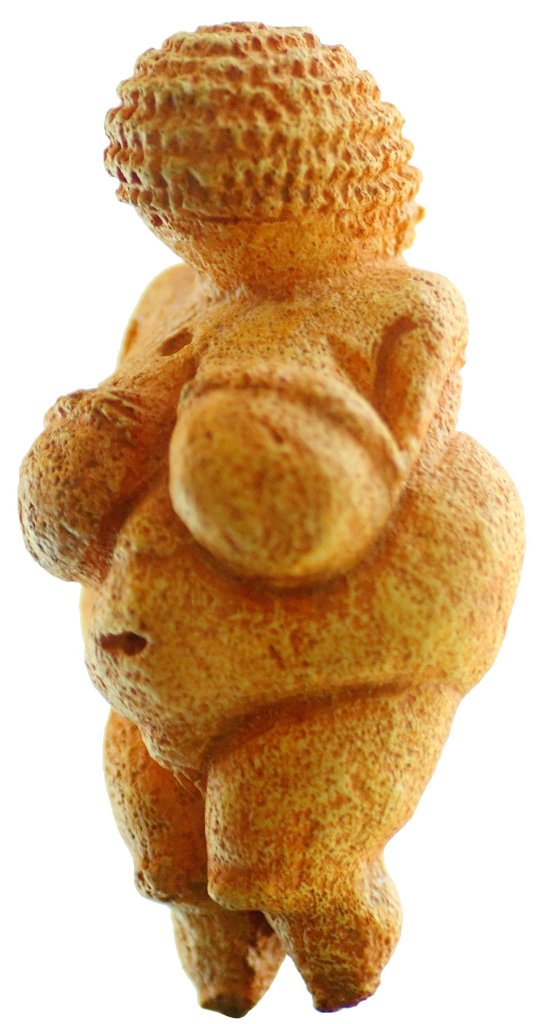
And a really great and super beautiful example of this is the Venus of Willendorf, which a lot of you may recognize the figurine. It’s a woman with very voluptuous features, and it’s a little carved statue that was actually painted with red ochre and it really serves as some of the first art.
And these Venus statues existed through time for a very long time. And to me, this is kind of one of the, the first like inklings of mythology that we had as proof for a long time that they have theories that she was a fertility token of fertility or like a talisman, or that it was an homage to some kind of mother goddess, or fertility deity.
Something that is indicating there is a lot of thought put into this and I’m sure that there were women of that time that. Really wanted to get pregnant and start life and pass onto their offspring. And so this is a really cool kind of first indicator 30,000 years ago that they were thinking, in this kind of mystical dimension.
But really for the most part, the prehistoric mythology bookshelf is pretty empty. We have some cave paintings and the oldest cave painting that we have discovered is actually in Indonesia.
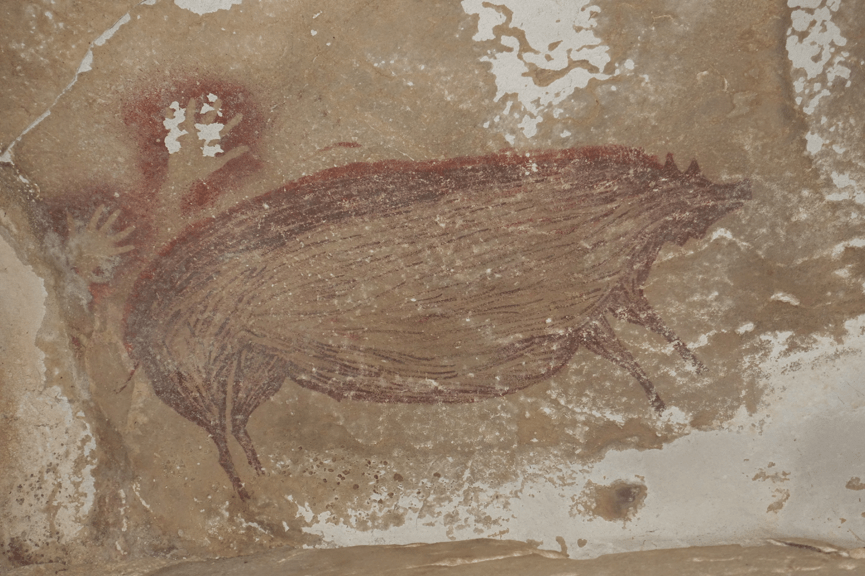
It was in a cave and it’s of a big giant pig that I’m assuming they slaughtered, and they’ve actually had a ways to identify the species of pig that was there in that time, to what those cave paintings were drawn of. I like to imagine the various reasons why they were deciding to put that on the wall of the cave. Were they boasting about this massive pig that they killed? Or were they being nice to the next hunters that, happened to be in that cave telling them kind of what’s on the menu for this land that like, hey, there’s some nice juicy big, pigs here, go out hunting and you might find one.
Or were they notes. To themselves that with when they were there next season that, oh, remember, this is the place to go hunting for these big pigs. And I say next season, because often we can think about the hunter gatherers as just complete nomads that. Just wander aimlessly and never come back to the same spot throughout the year.
But it’s really interesting. I read a book called The Dawn of Everything by David Grabber and David Wengrow, they’ve been discovering that there’s more likely to be, nomadic tracks that people were moving on and during different parts of the year, they would stay in different parts of the land.
Now does that, is that applicable for every nomadic group? Probably not. The example they used in that book, the Dawn of everything, was that whenever the colonists came here to the Americas, they were like, wow, this land is, it’s the land of plenty. The crops are growing, the soil is so rich, there’s all these natural, crops and things, and no one’s living here.
Why isn’t anyone living here? But it was more so an indicator that these cultures had been using this land over time, enriching the soil, doing crop rotation, and they just weren’t there 100% of the year. They had these tracks that they would travel and go from place to place, and they know that, oh, when we’re here, this is where the berries are.
This is where the animals, the deer are, this is where, the things that they go to, those pieces of land to benefit from. They just didn’t stay there the whole time. And so the colonists came in and were just like, wow, they’re crazy. They don’t wanna live here. But they did.
They just didn’t live there all year long. It’s like having a summer house and a winter house for different reasons. So back to the cave paintings, it’s really not an indicator of a mythology, even the Venus of Willendorf, these are things that we can point to that they are having more complex thoughts.
They are surveying the land. They are wanting to write down what. The land holds. They’re wanting to, maybe have this fertility and you can see the wheels are in motion, but without anything written, there’s really no way of knowing what myths they were telling.
During my research for this, I found some scientific studies that used genetic analysis that. Tried to genetically figure out what religious activities were going on in these hunter gatherer times, and predominantly it pointed to the idea of animism, which animism is the idea that everything in nature has a spiritual essence to it, whether it’s the squirrels, the deer.
But also the grass, the rocks, things that we don’t really think of as animated. And during this time, this is really when language started to develop, like the linguists have studied that, there’s certain vocal folds that evolved at certain times that made more range and pitch and sounds possible to even speak. They think that this proto language like an early form of language was a combination of sign language, using your hands and noises that people were able to make. But it wasn’t until like 130,000-100,000 years ago that a form of language really developed, which is really interesting when talking about the idea that animism was a proponent of their religion back then.
This is kind of like when language was developing, at least as far as they know, some theories or that it was. Much older than that. So it’s really hard to say one way or another, but there are some indicators that they were communicating with each other, they found the crafting of Red Ochre, which is a pigment
And this use of pigment and processing of the pigment in a specific way persisted throughout Africa, that showed the development of culture and the development of behavior in society. So although they may have still been in the phase of having a proto language where it’s a mix between mouth sounds and sign language,
They were on their way to communicating with each other, teaching skills, and in this instance, teaching the knowledge of making this red ochre pigment.
It’s really cool to think about those very first communicators and how they started expressing sounds and really they were our first creatives trying to make sounds in various ways. Maybe they were mimicking animal sounds, or remember when you were a kid and you just wanted to make weird noises with your mouth just because they were like that too, except there wasn’t a language to adhere to. They were literally being the very first creatives in the form of speaking and making sounds. To me, that’s just really trippy to think about and it’s cool thinking about the different styles and sounds that languages have.
A lot of this pre-history comes from Africa and the languages where it sounds like clicking. The first creative for them just may have picked those clicking sounds to start impersonating and refining and just these sound cool and a whole side of language that is very different than ours has developed in that way.
Was it because of one person’s just affinity towards the sounds of clicking and it’s just really interesting to think about now. Again, you might be thinking, what the heck does this have to do with mythology? Nadley, get on topic. And I promise that it does, because I wanna set up the stage as to what we’re dealing with in this pre-history time and how little we know about it really.
It’s just hard because we literally do not know the mythology because before written language there is no way of knowing or is there?
The Earliest Known Myth: The Seven Sisters
Here’s where I want to introduce to you the earliest known myth in history, and for anyone that paid attention in school, you may be saying, “I know it. I know it. The earliest myth is the epic of Gilgamesh”
And I regret to inform you that you’re wrong. That’s the earliest written myth. But what I’m gonna tell you is the earliest known oral. Just for a little bit of time reference, the Epic of Gilgamesh is from around 4,000 years ago, and the story that I’m about to tell you is from 100,000 years ago at least. This is the story of the Seven Sisters. This story shows up in Native American mythology. Aboriginal mythology, Greek mythology, Hindu mythology, Chinese the list goes on and on.
This story persists in culture all around the world. Like it is very widespread and not surprising, the story is very similar. In each of these cultures, whether it’s divided by continents, by time periods, this story and its core tenants have remained the same for a very long time. The stories are same, same, but slightly different.
Today I’m gonna focus on the Aboriginal Dream Time story of the Seven Sisters. The Aborigines people are the indigenous group from Australia. And dream time is the concept of the space before all of this began where time does not exist in the same way. Dream time stories are stories that tell of the creation of the universe, the creation of the earth, creation of humans, even laws, and even things like the dynamics of the food chain in nature.
In a simplified way to think about this, dream time stories are similar to the book of Genesis in the Bible.
There are different versions, but this is the one through the research that I’ve done, how I wanted to tell it.
So the story goes that long, long ago, in the dream time, there were the ancestral seven sisters that would come from the heavens to earth to support the growing life here on earth. They would come to earth via a cave, which was essentially their portal between the worlds. One day they were out foraging for food and.
Hunting and they were spotted by a man who is often depicted as another celestial being that had never seen such beautiful other beings before and became enamored, particularly with the youngest sister. He follows them, but they didn’t notice ’em at first. They were busy foraging, hunting. They were a little preoccupied.
So he follows them for a time, but then seeking the right moment, he ambushes them starting an epic chase. The sisters jump up, rush off and start the journey back to their cave of that they can use to go back to the heavens and get to safety, but we’re dealing with ancestral celestial beings.
This is not a normal foot race. Their pursuit carved the landscapes. The sisters having to create rocky hills and cliffs to hide behind or divert the attention from this man trying to escape his pursuit. They have to create watering holes for sustenance.
There’s even one story that tells of them digging a hole and traveling underground for some time and eventually coming back up to the surface of the earth, creating a through and through cave in the landscape. But the man still chased them. They did a lot of dip diving and dodging, but he was still on their tails.
Safety is in sight. They see the cave. They are right there. They are making their way, booking it to the entrance of the cave. But the man finally catches up and he snags the youngest sister taking her for his own, but in this last little stretch to get to that cave entrance, they didn’t notice that the sister had been gotten.
They were al some of ’em already got into the cave, portaled back up into the heavens, and did not realize that their youngest sister wasn’t there with them. Back on earth, all on her own. She is left defenseless. This man has captured her, but she does not give up the fight. She squirms, she kicks. She just, she’s probably like bit them, I don’t know, but she gets away. She eventually gets free from his grasp and she books it for the cave. She gets there safely. She gets transported up to the heavens with her sisters, but this man did not stop there. He also enters the cave and he sent into the stars. Just after her, but this was the sister’s domain.
This was their home. They were used to traversing the stars. They were able to conceal and protect the youngest sister and hide her away. And while the hunter was there, he was frozen in the stars just out of reach ’cause this was not his domain.
And so, if you haven’t caught on by now, this is the story of the group of stars called the Pleiades. And it has been told one way or another by nearly every culture throughout time.
Probably the most well known is the story from Greek mythology where Zeus had banished Atlas to the very arduous task of holding up the sky, holding up the heavens. And Atlas had these seven daughters that he left defenseless because he was not there to protect him anymore.
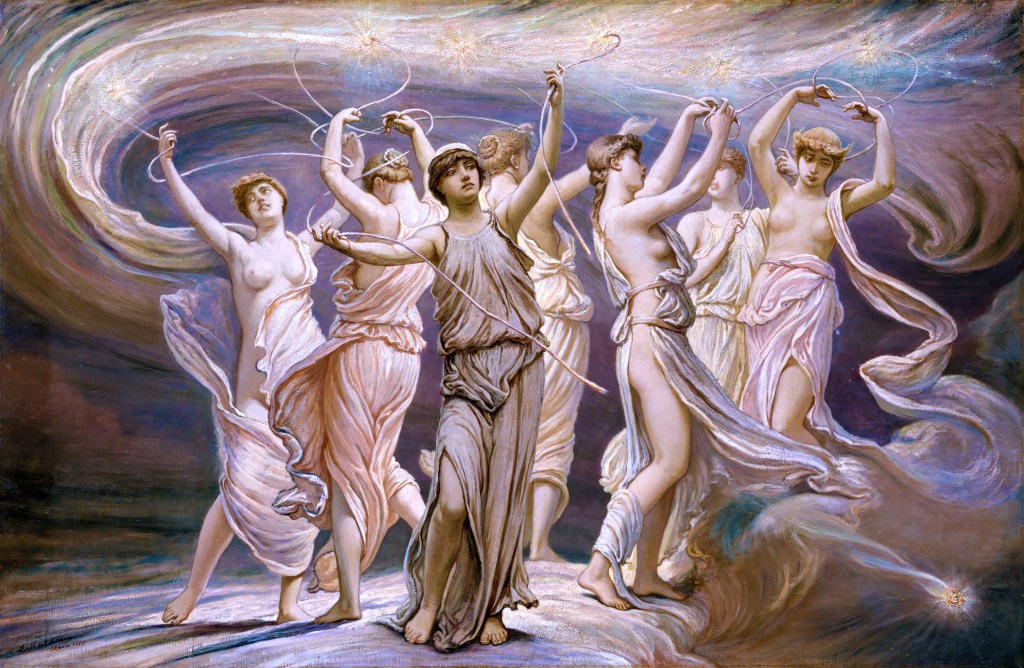
And Orion was again captivated by their beauty and pursued them. Eventually Zeus intervened, you know, even though he was the one that made Atlas hold the sky up forever. He’s not completely heartless. He intervened, said, enough is enough. First he turned them into Doves, seven doves, but then eventually immortalized them, putting them up into the stars so that Atlas, their father, did not have to worry about them anymore.
Orion, however, did not give up the chase either, as you can still see him chasing them today.
The Orion constellation sits right next to the Pleiades Star cluster, but he is just barely out of reach. Can’t seem to get him. So you might be wondering, how do we know that this story has been told for a 100,000 years, especially since the oldest written myth is around 5,000 years ago, a 100,000 5,000. That’s a big difference. And oral traditions. And oral storytelling is nearly impossible to trace back. It’s a a hundred thousand year old game of telephone and you can play a game of telephone in one little circle of 10 people, and it’s going to end up very different.
So how do we know that this story has lasted for that long? Not to be cheesy, but the answer is quite literally written in the stars, and the stars are telling us that this story has been around for a very, very long time.
The Pleiades
The Pleiades Star cluster is around 444 light years away, making it one of the closest groups of stars that we have.
This makes it pretty easy to pick out with the naked eye. On winter nights, you can find this cluster of stars fairly easy, and if you have good eyesight, you can count the stars that are most notable making up the cluster. But you’re not gonna count seven stars like the Seven Sisters. There’s only six.
For any car people out there, the Subaru emblem is of the Pleiades, and it shows six stars, six stars that make up its logo. And fun fact, Subaru actually means Pleiades in Japanese.

So why are all of these cultures telling the story of the seven sisters?
If there’s only six? And this seriously just makes me so happy, the intersection of the science with mythology is just so cool. There are astronomers that have run simulations and knowing that stars move over time and the paths at which they do move over time, they have mapped what the stars would’ve looked like on Earth a 100,000 years ago.
And when you run that simulation. We can see that that seventh star was visible. You could see all seven with your naked eye. And now in the Stars, that seventh Star is obviously still there, but it’s just behind one of the other stars, so you can’t pick them out as different. They’re just in one line.
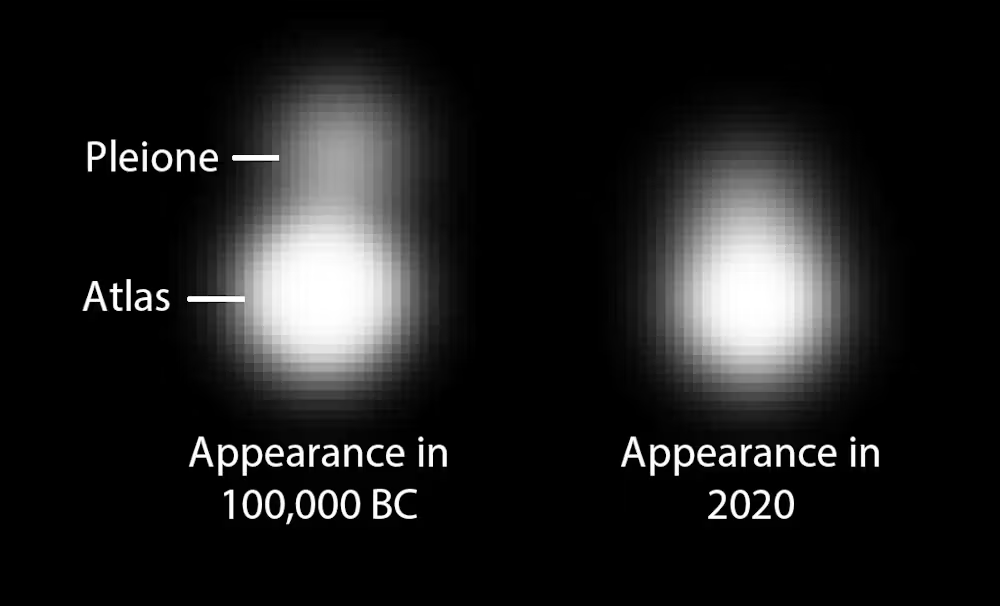
but if you were around a hundred thousand years ago, you could, and just to be clear, the whole Pleiades star cluster is made up of thousands of stars. But these seven stars are the cornerstone of that group that were able to be pointed out in the sky and it seems that some other cultures knew that there were more stars in that area.
There are some depictions of the Pleiades in Inca Art that showed 13 stars, but when talking about it, even though they knew there were more stars involved, they still called it the Seven Eyes of Viracocha, which is one of their creator gods. So even though they’re saying, we know there’s more than seven stars here, it was still called the Seven Eyes.
So seven was very concretely known for being, that star cluster, everyone referenced it as seven, and this isn’t even something that could have evolved as a story being told in one area and then spread over time. There’s indicators that these stories were being told by Aborigine people in Australia well before it was colonized and contacted by, say, the Greek myths or any of those things, these stories go back tens of thousands of years before there was any documented. Way of how this myth spread. It seems like this goes back all the way, hundreds of thousands of years ago to the time when we were a newly budding people leaving the continent of Africa.
And it seems there were groups of people telling these stories of the Pleiades. And these stories stayed with the people from the first, well, actually second migration. In just a little caveat, there’s a theory, there’s a couple theories that people migrated off of the continent of Africa and made it pretty far in various places, but because of, different climate variables, it seems like most of those first wave of migrators died off, or came back to Africa and there was really like a second migration around a hundred thousand years ago that, that lasted, that people migrated and they stayed, they didn’t come back to Africa. So I wanna say this story can be from that first wave of leaving Africa, but it’s actually the second.
I imagine there’s a group sitting around a fire telling this story about the Pleiades, the seven sisters not knowing that this story is going to keep hold in society for hundreds of thousands of years. That is so mind blowing that oral traditions can really stay rooted in society.
And I also wanna make it clear that the variables of this Seven Sisters story has absolutely shifted over time to suit the culture and society. Just like we were talking about in the beginning, that each function of the myth serves a purpose for the societies within it. So the core tenets of this have stayed pretty well trenched in this story, but the variables have changed quite a bit.
And if you think about it, the fact that we only see six stars and the story tells of the reason why that seventh star is hidden behind one of the other sisters. She’s hiding her from Orion or for that pursuer. I imagine that the story they were telling when there were seven stars. Was different, but they somehow knew that there were seven stars there.
They knew that that star was tucked behind the other one hiding.
I don’t want you to think I’m saying they were telling this exact story the same way for that long, but them knowing the seventh sister was there, shows that they did see those seven stars and that knowing the seventh Star was there is only possible having it been passed down for so many years. But I really wonder what the original story was like before that seventh sister was hidden behind the other stars.
Even the story that I just recapped was watered down or I shifted in various ways to make it fit. ‘Cause in some Aboriginal stories of the Seven Sisters there was more of a theme of forbidden love, where he was not her captor, they were actually in love, but the sisters couldn’t let them be together because it was against the rules that that was another group that they were not allowed to mate with.
And the use of that part of the story is to you know, reinforce the laws and reinforce the social rules within society, which was that third function, the sociological function. It was really interesting to see this rule of not being able to marry certain other groups within these aboriginal circles that some pointed out to be kind of from a prejudice point of view, like we don’t, we don’t mix with them, but I saw a lot of indicators of knowing that certain groups were more genetically related to each other, so they weren’t allowed to be with them because it was like too close of genetic mixing. So it was very interesting that they knew back then that breeding, similar genetics like pure bred dogs, if you breed ’em, they have a lot of problems and health issues. So it’s like they, they knew these things back then and used these myths to point out that we don’t marry those people. And this story has persisted through into our culture now, the theme of Forbidden Love.
In storylines like Romeo and Juliet, Jack and Rose on the Titanic. Which is funny because Jack and Rose on the Titanic, the Pleiades story from Greek mythology, Atlas was a Titan, the Titanic, I don’t know. Little synchronicity. But even like Edward and Bella from Twilight, they’re like, oh, we can’t be together.
This forbidden love. These themes still persist today just molded to fit our society. And it might be hard to believe that this story has remained intact for a hundred thousand years. But what is really, really important to remember is the Pleiades is not just a normal group of stars in the sky that are just pretty to look at.
They have literally kept people alive. The Pleiades were used to track time, they were used for navigation, they guided agricultural practices, when to do this, when to do that, and used for sailing and there’s a reason these stories were told, like they had to continuously be aware of the Pleiades.
They had to know where it was, what it was doing, what’s going on with it. And so this story kept that knowledge alive in all these various cultures all over the world that used it to their benefit. In the northern hemisphere, the Pleiades are associated with the beginning of winter. The cluster of stars rises just above the horizon in around October, and then dips back below the horizon in April.
There’s a nomadic tribe in, the Sahara Desert called the Tuareg people, and they are a part of the Amazigh people. They called the Pleiades, Cat ihed, which means Daughters of the Night, and they have a proverb that says, when the Pleiades fall, I wake looking for my goat skin bag to drink. When the Pleiades rise, I wake looking for clothes to wear.
The Tuareg tribe of the Amazigh people are nomadic in nature. So keeping account of what season we are about to go into is really important.
If the Pleiades comes up above the horizon for this part of the year, then we know we’re gonna need some extra clothes because it’s gonna be cold.
also little note about the Amazigh people. A lot of you may be more familiar with their other.
Name the Berber, but I’m gonna tell you why I don’t use that term. Because in the Punic Wars around like 2200 years ago when Rome was trying to conquer North Africa, they called them barbarians and uncivilized. So the word in Latin was barbaros. And so they kept that name. Practically just calling this whole group of people barbarians.
And it eventually changed phonetically to the Berber. So if you hear someone talking about the Berber or the Berber culture language, you can rightfully correct them and call them the amazigh.
And since they were a nomadic tribe, like even still today, the torics are a nomadic tribe, and so they don’t really have a state that represents their culture predominantly.
And so the name Berber just. Stuck and they didn’t have any state sticking up for them. So it’s kind of on us to stop calling them that. So Amazigh is the people. Tuareg was one of the tribes within those people, and I love them a lot. They have really beautiful art and really rich history, and I actually have, this is called a Tuareg cross. It is. A necklace that I got from a shop in North Carolina that I was just very much so drawn to and began researching about the Tuareg tribe after seeing this beautiful symbol, and I wanted to learn more about it.
So I stick up for my Amazigh people. We don’t call them Berber. Any who. So if you remember in the Dream Time story of the Aborigines. When the sisters were fleeing, they were creating the landscape. They were pushing a bunch of rocks up into one area, hiding behind it.
They were forming water holes to get sustenance. They were digging caves to escape. They were effectively describing the landscape, and this is such a beautiful use of myth that I learned about when I started researching into these aborigine myths, is the idea of what they call a song line. Which is basically telling the story as a form of a verbal map.
So as they’re moving across the landscapes, the sisters went here, they did this, they did this. There was this watering hole, there was this cave, da dah, dah, dah. This story they’re telling gives you a map in your head so you know what parts of the landscape, if you’re traveling that area that you’re going to come across.
There are other really beautiful song lines that the Aborigine people tell, and there are a lot of different Aborigines, cultures that it’s just similar to. You can’t just say Native American and. There’s so many different tribes within the Native American umbrella. Same thing in Australia with the Aborigine people.
They have these various stories and songlines that they tell that tells you of the land, it educates you of the topography of the geography, of the path that you should go if you’re traveling it. And, if it’s like a little bit hard to understand, a dumbed down version of this that we might be a little more familiar with is when, how, back in the day, givin’ directions, you might say, when you see the tree that splits into two turn left, go down that road for a while until you see a rock that looks like a goose egg. if you’ve gone and you see a Brushy Creek on your left, you’ve gone too far.
That’s basically the idea and the concept of these song lines, but you know, a bit more richer in history and meaning than just telling your friend were to go before maps was a thing.
The Relevance of Mythology Today
So I believe the Seven Sisters myth checks all the boxes for what Joseph Campbell said qualifies a story to be a myth, which makes me confident in saying that it is one of our oldest myths that we know of.
The mystical function is the awe of the stars and the landscapes. The cosmological function is the idea that the sisters are coming down to earth and their chase is shifting the landscape
and explaining why the landscape looks like that giving reason to what they’re seeing in the physical world and the sociological function is that the story was used to explain laws for certain groups that were not supposed to mix with others. And the pedagogical function is the lessons that it taught them. For this story, it could be a lot of things that the sisters didn’t notice that they were being followed. Maybe it should be to tell you to be more mindful and attentive and observant whenever you’re out in the brush, particularly in Australia, when you’re somewhere where everything wants to kill you, not just the men. It could have taught you that you have to fight your own battles sometimes, that your sisters are not always gonna be there, and you have to fight off your captor that you can’t rely on others to help you sometimes. And the big one that I think that this myth teaches specifically in the Aboriginal sense is it, it’s a geography lesson.
It tells you the topography of the land, and you know you’re going the right direction when you see the next point in the story. Ah, the sisters were here. Ah, that’s the rocky cliff. Ah, that’s this, that’s that.
And that’s why I think this myth has stuck with us, and these myths evolve over time. They benefit society. They’ve kept us alive literally. Maybe that’s why these myths and this practice of storytelling and mythology has been harder to keep alive because we don’t need this knowledge to save our life.
We don’t need this knowledge to know what the topography of Australia is. We have maps, we have all this technology.
We don’t need to be told when to plant our crops. But I believe that we desperately still need these myths for some of those other functions. How to human, how to go through these phases of life to where you understand that you’re not alone, that you aren’t the only one suffering through these things, that life is hard.
Life has challenges, and sometimes you need a little bit of a playbook to help you understand how to get there, how to cope. I believe that myths over time have stopped having all four of those functions that tie together. You know, the awe of the universe, the knowledge of the world, that we have, the, rules of society and the information that teaches us how to exist and how to cope with going through life.
We’ve focused a lot on one of these functions, which is the sociological function that tells us how we’re supposed to show up in society but without all of the other functions mixed in with it we we’re just being told what to do and there’s no connection. There’s no why. There’s no awe of the universe mixed in with it. There’s no, you know, pursuit of explaining the natural world. There’s, there’s just the rules. It’s not even containing the ideas why we need to do these rules and why they’ll help us cope, why they matter. So when rules and law and law and order, which is a term that they love to use these days, when that’s the only function.
The laws become over-prescribed. Lacking the how, lacking the why it matters, making it harder to follow, making it not have any substance, and we hate being told what to do. So many people, when we’re told what to do, myself included, I don’t wanna do it anymore. If you tell me what to do, I’m not doing it.
You tell me why. I’d be like, Hmm, maybe that makes sense. An example of this is the plethora of rules in the Abrahamic religions like Christianity that dictate things like not mixing two fabrics together, or that you have to marry your brother’s wife if your brother dies before you guys had kids, that’s a law in the Bible. I mean, we could get into a lot of other laws that have not been necessary to continue to exist in this society. But there’s no explaining, there’s no reason why these things benefit our society and like the Aboriginal myths that you aren’t supposed to mix. ’cause we’re related.
That, I mean that, that’s a pretty. Pretty flat out make sense kind of rule. But they still had to have these stories that explain and make you understand why the rules are the rules. But just like the Seven Sisters myth myths get dated very fast.
What was necessary for one society does not transfer properly over thousands of years, and each generation should continuously hone and keep alive the certain things that help our society thrive in this moment of time, because america being a predominantly Christian nation. That book was written thousands of years ago, and it’s not pertinent in those laws and those rules. It’s not pertinent to us today. Do I think that the teachings of Jesus would have immense benefit for our culture today?
Absolutely.
Do I think that christian churches on the whole represent Jesus’ ideals and Jesus’ teachings?
Absolutely not.
I have a little story about how one church that I went to at a moment in time for a Halloween haunted house, a religious haunted house had a very big effect on me. The way that I feel some of these stories and myths affected past cultures, and honestly, it worked on me. So it was a haunted house and you go through various rooms and you’re following this man’s life, and he is kind of a bad boy and he drives a motorcycle.
I think he smoked cigarettes and, but he was not a terrible person. He didn’t just murder people and stuff. He, he was a pretty good person, but he didn’t do the things that he knew were right and. One day he dies on the motorcycle, I think. And so the next room that you go into after that, he’s with St. Peter at the Pearly gates and he has the Book of Judgment and he is delivering to this motorcycle man. What should be, you know he is delivering the verdict to this motorcycle man that has wound up for judgment and he’s looking over, his life and what he is done.
And he says, you know, you didn’t kill, you didn’t have adultery, you didn’t lie. You didn’t, you know this. And he is, so, it’s kind of like, okay, maybe this guy’s gonna get into heaven. Okay. And he said, but you judged your fellow man. And the Lord says, only he may judge. The verse, judge, not lest ye be judged.
And so Peter says, you’re not making it into heaven. And he goes to the next room and he’s in hell now. And I was like eight, nine, maybe, and I was, oh my God. We don’t judge people. It worked on me. I was stricken with the fear of judging peoples that that would lead you to hell. And, and I kept that with me.
And then as I grew up in the church. I was like, wait, why are y’all judging everybody? Didn’t you go to that same haunted house? Don’t you know it didn’t matter that, that guy’s was good in all the other categories but he judged his fellow man, and that wound him up in hell. It got to me.
But growing up I realized the rest of the church doesn’t necessarily follow those same rules, and that to me was like a slice of mythology. The storytelling, how it applies to my life, why I should do it. It worked on me, but I’m putting that fun story aside today. I still think we get aspects of the four functions.
Life, but they’re not all in one pretty little package, like how they were delivered in myths back in the day. , We can still easily access that mystical function just going out into nature, looking up at the stars, wondering and being in awe of, the nature and what’s out there, the cosmological function to me, you can just blanket that function as science, the pursuit of wanting to figure out everything, explain the land, explain why things happen. Use it to explain the mystical parts of life. Then the sociological function, which we’ve talked kind of the most about
that’s the one that’s off the charts, and I feel like just the political situation in our world right now is a big indicator that is over-prescribed. The dictating of micro habits that we should be doing and believing. And if you’re not one of them, you’re one of them. And it’s just, it’s gotten a little bit far off the scales.
I think that nowadays that people are so susceptible to cults is another indicator of this. And you know, you can watch a cult documentary and think, how could that have happened to them? That would never happen to me. But there’s something inside humans where we want to be told what to do. We want to be told this knowledge, this secret knowledge that really just holds on, but it doesn’t have the substance.
Or if it does, it’s fabricated and it’s really because of a personality behind the cult that is running the shots. It’s not connected back to that awe of the universe, what we know about now and how it can help us survive. And the pedagogical function, the one that teaches you lessons on how to be alive.
I think that function is very alive and well in the form of self-help books now and self-help books just aren’t as fun to read. Compared to, I mean, they’re great, but compared to, epic stories and you’re like entrenched in the story and everything else goes away, and you can gain benefit from these myths and these stories by use of your imagination.
There’s something about self-help books that just feel like a punishment, like you’re sitting with what you feel is wrong with you? How can I fix it? And it’s just, it’s not as lighthearted and I think it puts a lot of pressure on you. So even though these four functions exist in our society now, they’re all separate spheres that you can dip your toes into, but there’s not a lot of overlapping of those four.
And some might overlap here and there, but it seems that the real magic happens whenever you have one little easily prescribed myth or lesson that hits on all of these things to make you feel like you’re on the right track. You make sense, it all makes sense. This is why I’m here. They’re all striking the same chord at the same time, and it amplifies the benefit that makes it more than just a fun story about Greek gods messing with humans.
So after I started down this journey and just started becoming more interested in myths and wanting to get into mythology. I realized how much it served society for thousands of years, and I realized it kind of need a little bit of rebranding. ’cause even like now when I’m trying to promote my podcast, I say that it’s about mythology and I feel like it just brands it as, oh, we’re gonna talk about Norse Gods and, and we are like, we are gonna talk about all that stuff, but it’s not just something to nerd out about because it happened in the past, the idea of mythology is to benefit society, and our fast-paced society now is just not really able to have something like a myth or a story, this oral history, hold on to it because everything moves so fast. So. I literally sit in bed at night thinking, what is our version of a myth?
How do we even approach it when things just come at you so fast? Life evolves so quickly nowadays that it’s hard to pinpoint how we approach this kind of topic that would benefit society, and that I think that the mental health struggles that we have. Could be lessened if there was a way to get these myths into our hearts again and into our mind, and make us feel connected with the universe, with the natural world, with each other, and have it be a guide into helping us live a happy life.
So it’s a big task. But all in all, I hope this episode has myth busted mythology a little bit for you, and has broken down that idea that you might have had in your mind of what mythology is and how it’s a worthwhile thing to invest your time in. So if you enjoyed this episode, I encourage you to share it with a friend, share it with a family member that you think would enjoy this topic.
I’m just starting out, I’m gaining my audience very slowly and I love each and every person that listens, and I would love to reach more people that are into this kind of thing. I post these blogs of the transcript but also video podcast versions are available on YouTube and Spotify and audio podcasts are available on Apple Podcast and all other major podcast platforms.
Sources & Image Credits:
https://www.metmuseum.org/essays/epic-of-creation-mesopotamia https://news.griffith.edu.au/2021/01/14/worlds-oldest-cave-art-discovered-in-indonesia/
https://pmc.ncbi.nlm.nih.gov/articles/PMC4958132/ https://www.cambridge.org/core/journals/iraq/article/of-captive-storm-gods-and-cunning-foxes-new-insights-into-early-sumerian-mythology-with-an-edition-of-ni-12501/391CFC6A9361C23A0E7AF159F565A911
https://pmc.ncbi.nlm.nih.gov/articles/PMC7902358/#:~:text=Venus%20Figurines%20from%20Northern%20France,Willendorf%2C%20Germany%2028K%3B%20C
https://www.britannica.com/event/Paleolithic-Period
https://jlunceford506.weebly.com/lesson-2.html
https://theconversation.com/the-worlds-oldest-story-astronomers-say-global-myths-about-seven-sisters-stars-may-reach-back-100-000-years-151568 https://en.wikipedia.org/wiki/Venus_of_Willendorf
https://www.aboriginal-art-australia.com/aboriginal-art-library/aboriginal-dreamtime/?srsltid=AfmBOorcaeV8rSg0Y15oEL25iwOnZ1eQAwQj-9YJmXoQ0iYVUSLqs2AG https://www.kateowengallery.com/page/The-Seven-Sisters-Dreamtime-Story
https://www.google.com/books/edition/The_Seven_Sisters_of_the_Pleiades/3GbYg26S8pUC?hl=en&gbpv=1&dq=the+seven+sisters+aboriginal+myth&pg=PA1&printsec=frontcover https://emergencemagazine.org/essay/a-universal-lesson-of-the-seven-sisters-story/
Image credits:
By Joan Halifax – flickr_url: [1], CC BY 2.0, https://commons.wikimedia.org/w/index.php?curid=17242629 By User:MatthiasKabel – Own work, CC BY 2.5, https://commons.wikimedia.org/w/index.php?curid=1526553 By Taurus_constellation_map.png: Torsten Brongerderivative work: Kxx (talk) – Taurus_constellation_map.png, CC BY-SA 3.0, https://commons.wikimedia.org/w/index.php?curid=10945356 https://news.griffith.edu.au/2021/01/14/worlds-oldest-cave-art-discovered-in-indonesia/ By NASA, ESA, AURA/Caltech, Palomar ObservatoryThe science team consists of: D. Soderblom and E. Nelan (STScI), F. Benedict and B. Arthur (U. Texas), and B. Jones (Lick Obs.) – https://hubblesite.org/contents/media/images/2004/20/1562-Image.html?Topic=104-stars-and-nebulas&keyword=pleiades (TIF image link), Public Domain, https://commons.wikimedia.org/w/index.php?curid=7805481 By Subaru Corporation – https://subaru.it/, Public Domain, https://commons.wikimedia.org/w/index.php?curid=150315037
 Nad Knows
Leave a comment